
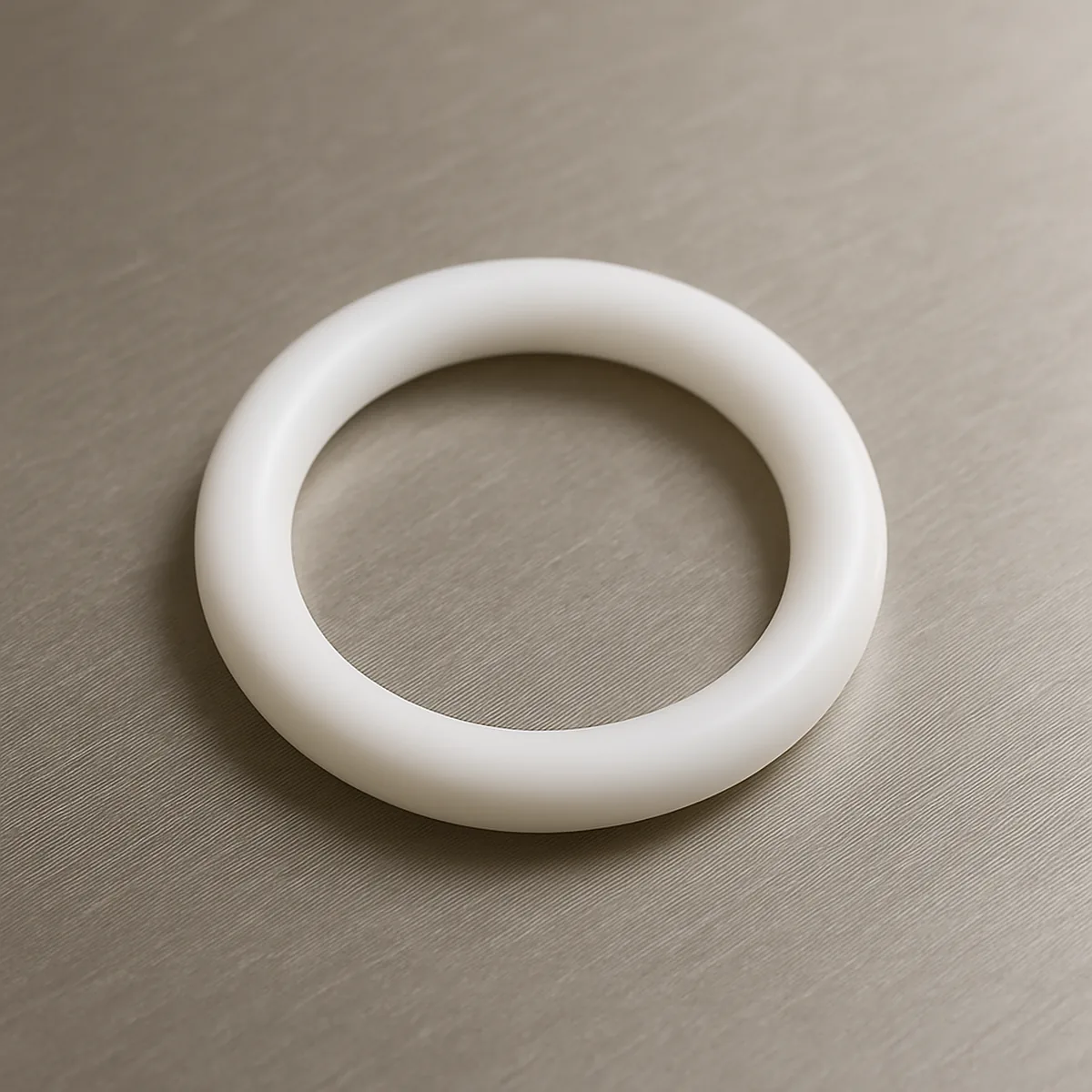
When should you use PTFE O-rings?
PTFE O-rings are used in highly demanding industrial applications, especially when high chemical resistance, high temperature and/or a low coefficient of friction are required. That said, they are not always the best option: PTFE is a material with low elasticity and a tendency to creep under load, which affects its sealing behaviour.
In this post we summarise when it is advisable to use PTFE O-rings,when it is best to avoid them and which alternatives may be a better fit depending on the service.
For more information on custom PTFE and Teflon® gaskets, click here
When PTFE O-rings are recommended
1) Highly aggressive chemical environments
PTFE is practically inert to most chemicals. That is why PTFE O-rings are common in:
- The chemical and petrochemical industry.
- Process plants handling acids, bases and aggressive solvents.
- Laboratories and instrumentation with high chemical compatibility requirements.
2) High-temperature applications
When the operating temperature exceeds the usual range of elastomers (depending on the compound), PTFE can be a good solution. It is common in:
- High-temperature process equipment.
- Installations with demanding thermal cycles.
- Areas close to heat sources that require sealing.
3) Applications requiring low friction
The low coefficient of friction of PTFE can be useful in smooth movements or mechanisms where friction and seizing need to be reduced, especially in:
- Components with slow or intermittent movement.
- Applications where “stick-slip” should be minimised.
- Systems where chemical compatibility rules out other materials.
When they are NOT recommended (or extra care is needed)
1) Sealing that requires high elasticity
An O-ring works through elastic deformation. In PTFE this deformation is limited, so it may not seal well where there is:
- Vibration.
- Misalignment.
- Repetitive movement requiring the material to “recover”.
In these cases an elastomer (EPDM, NBR, FKM, etc.) or a hybrid solution is usually preferable, depending on the medium and temperature.
2) High pressure with a risk of extrusion
At high pressures, PTFE can extrude if tolerances are not tightly controlled. In these cases it may be necessary to:
- Optimise the groove geometry.
- Consider back-up rings.
- Consider filled PTFE or alternative sealing solutions.
3) Wide assembly tolerances
PTFE requires precise groove geometries. If there are clearances, uneven surfaces or “rough” machining, the risk of leakage increases.
4) Low-cost or general-purpose applications
PTFE is usually more expensive than many elastomers and, unless there is a clear technical reason (chemicals/temperature/compatibility), it is normally not justified.
Quick selection checklist (PTFE O-ring)
- Static or dynamic sealing? In dynamic applications, watch wear/fit and actual friction.
- Which fluid and concentration? This is where PTFE usually excels if the chemistry is aggressive.
- Temperature and cycles? Take expansion and seal relaxation into account.
- Pressure and clearances? If there is a risk of extrusion, consider back-up rings or an alternative.
- Surface finish and tolerances? Critical with PTFE to avoid micro-leaks.
Common alternatives to PTFE (depending on the application)
Depending on the service, other materials are often a better fit:
- EPDM for water, steam and outdoor use (ozone/UV).
- NBR for oils, fuels and hydraulic systems.
- FKM for a combination of high temperature and moderate chemical resistance.
- Silicone for technical/food applications that require elasticity.
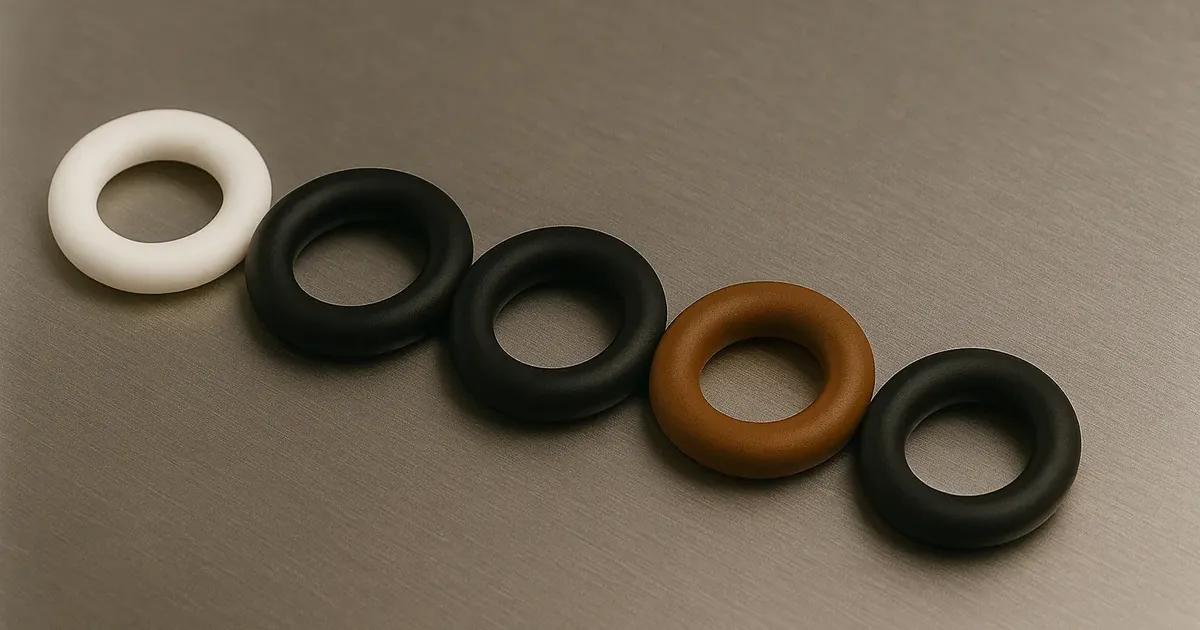
When chemical resistance is required but also better elastic “recovery”, a common option is encapsulated O-rings (FEP/PFA), which combine an elastic core with a chemically resistant jacket.
Conclusion
PTFE O-rings are recommended when chemicals and/or temperature make a standard elastomer unworkable, and when the groove design and tolerances allow reliable sealing. If the application requires a lot of elasticity, vibration absorption or “forgiving” assemblies, it is usually better to opt for an elastomer or a hybrid solution.