
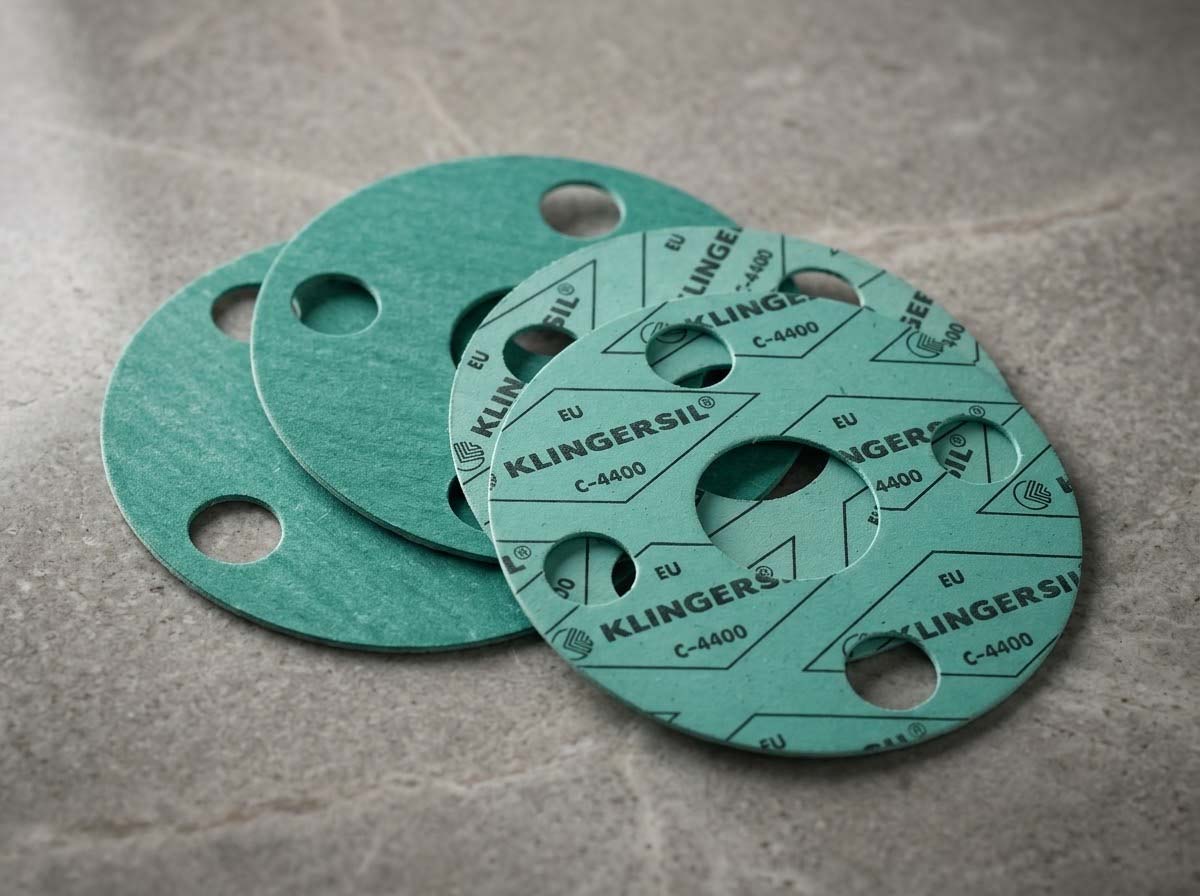
What klingerit is and what it is used for in industrial gaskets
Klingerit is a term that for years has been used in industry to refer generically to compressed fibre gaskets. Although it was originally linked to a trade name, it is still used today in workshops, maintenance departments and industrial plants as a synonym for a compressed fibre sealing gasket.
In practice, when a company asks for a klingerit gasket, it is usually referring to a flat sealing gasket for flanges, valves, pumps or pipework, made from compressed fibre or a current equivalent depending on the application.
What exactly is klingerit?
The term klingerit became popular in industry to identify materials used in the manufacture of sealing gaskets. Over time, the name stopped being understood solely as a trade reference and came to be used generically to mean compressed fibre gaskets.
That is why maintenance, purchasing and engineering managers still often talk about “klingerit gaskets” when what they actually need is a compressed fibre flat gasket suited to specific operating conditions.
What klingerit or compressed fibre gaskets are used for
These gaskets are used in many industrial applications where a seal between two surfaces is required. They are common in assemblies with flanges, covers, pumps, valves and equipment through which fluids or gases flow.
- Flanged joints in industrial installations
- Equipment for water, air, oils and other compatible fluids
- Industrial maintenance and repair systems
- Assemblies requiring a custom die-cut flat gasket
The suitability of the material always depends on factors such as temperature, pressure, fluid, the type of closure and the actual service conditions.
From klingerit to compressed fibre: how the material has evolved
The evolution of industrial gaskets means that today there are various materials that are equivalent or alternative to traditional klingerit. Rather than simply using a historical name, in many cases the right approach is to define the solution according to the application and select the most suitable material for each use.
Today, when you need a gasket of this type, what matters is not so much the name you order it by, but having a clear understanding of:
- what fluid it must seal,
- what temperature it will operate at,
- what pressure it will withstand,
- what geometry the part needs,
- and what mechanical and chemical behaviour is expected from the material.
How to choose the right compressed fibre gasket
If a company is looking for a solution equivalent to a klingerit gasket, it is advisable to start from basic technical criteria before requesting a quote or manufacturing the part.
- Fluid: water, steam, air, oil and chemicals are not the same.
- Operating temperature: determines how the material behaves.
- Pressure: affects sealing capacity and the right thickness.
- Gasket format: flat gasket, flange gasket, custom die-cut part, etc.
- Material compatibility: key to avoiding premature failures or leaks.
That is why, in industrial environments, it is best to work with a supplier that can manufacture the gasket to measure and guide material selection according to the actual use.
How does klingerit differ from other gasket materials?
The term klingerit is usually associated with compressed fibre gaskets, but not all industrial applications should be solved with this type of material. Depending on the operating environment, rubber, PTFE, graphite or other engineered compound gaskets may also be used.
The choice depends on the chemical, thermal and mechanical demands of each installation. That is why, rather than simply looking for “klingerit”, it is worth assessing which type of gasket offers the best response for the specific application.
Custom manufacture of compressed fibre gaskets
In many cases, compressed fibre gaskets are not supplied as standard parts but are manufactured to a drawing, sample or specific dimensions. This allows the gasket geometry to be adapted to the actual equipment and ensures a better fit on assembly.
If you need an industrial sealing solution, you can visit our compressed fibre gaskets page, where you will find more information about this type of manufacturing and its applications.
And if you are also looking for die-cut parts in this material for other uses, you can also see our compressed fibre washers.
Ask us for technical advice on your compressed fibre gasket
If you already have a drawing or sample, send us the information and we will confirm feasibility and lead time.
Contact our technical departmentFrequently asked questions about klingerit
Is klingerit a brand or a type of material?
It was originally a trade name, but over time the term has come to be used generically for compressed fibre gaskets in industrial applications.
What is a klingerit gasket?
It is normally a flat gasket used for sealing flanges, valves, pumps or pipework, made from compressed fibre or equivalent materials depending on the application.
When should compressed fibre gaskets be used?
When the operating conditions, the fluid and the closure system are compatible with this material. To choose correctly, it is advisable to check the temperature, pressure, thickness and geometry of the gasket.
Are all klingerit gaskets the same?
No. Although the term is used generically, the composition, behaviour and suitability of the material can vary depending on the manufacturer and the intended application.
Can compressed fibre gaskets be custom-made?
Yes. They are commonly made to measure from a drawing, sample or specific dimensions to suit the equipment or installation in which they will work.
Need compressed fibre gaskets for your application?
At Manufactures Cusell we manufacture custom compressed fibre gaskets for industrial applications, adapted to the dimensions and requirements of each project.