
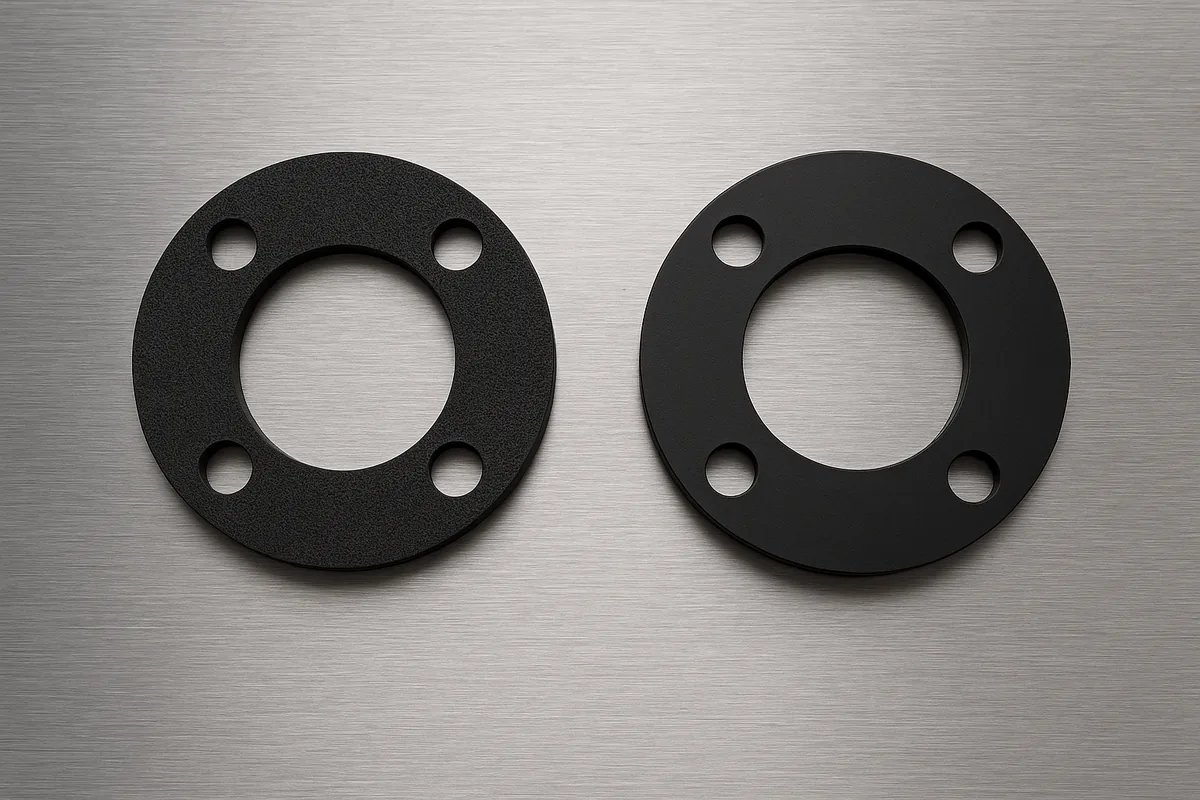
Solid vs sponge gaskets in the railway sector
In the railway sector, where safety, reliability and durability are essential, the type of gasket chosen has a direct impact on system performance. Although solid and sponge gaskets are both made from technical rubbers, they behave very differently. In this post we look at the advantages that solid gaskets offer over sponge gaskets in railway transport applications.
Quick summary (railway):
- Solid gasket: better for demanding sealing, oils/greases, outdoor use and mechanical impacts.
- Sponge gasket: better for light sealing, compensating for irregularities and acoustic insulation.
- If there is pressure or contact with fuels/oils, a solid gasket (NBR/FKM) usually performs better.
- If the priority is absorption and comfort (noise/vibration), a sponge gasket is usually a better fit.
Scope of this article: this comparison focuses on railway applications (vibration, weathering, oils/greases and mechanical demands). If you need a custom rubber solution or would like more commercial information on materials and formats, see our main rubber gaskets page.
Differences between solid and sponge gaskets
Solid gaskets are made from dense, closed-structure rubbers such as EPDM, NBR or FKM, with hardnesses between 50 and 90 Shore A. This type of material has a non-porous structure with low compressibility, which allows it to retain its shape and properties even under high loads or pressures.
Sponge gaskets, by contrast, are made from cellular rubbers (expanded EPDM, silicone sponge or cellular neoprene), with an internal structure full of air micro-cells. They are lighter and more deformable, which makes them suitable for low-pressure sealing or acoustic insulation.
In railway applications, where operating conditions are demanding and vibration is constant, solid gaskets generally offer superior performance in terms of sealing, mechanical strength and durability.
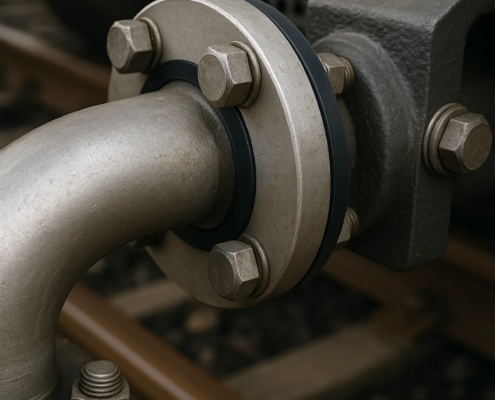
Main advantages of solid gaskets in railway applications
- Greater mechanical strength and dimensional stability
Solid gaskets retain their shape under pressure and do not deform over time. In railway systems, where components are under continuous compression, this helps ensure a stable seal and reduces the risk of leaks or pressure loss. - Better resistance to oils, fuels and chemical agents
Solid rubbers such as NBR or FKM offer excellent resistance to oils, greases and fuels, which are common in engine areas, hydraulic systems and rolling stock gearboxes. - Greater durability in extreme environmental conditions
Outdoors, solid EPDM gaskets offer high resistance to ozone, UV rays and weathering. This reduces premature deterioration, hardening and cracking, ensuring a longer service life. - Reliable sealing under vibration and continuous movement
Solid rubber absorbs dynamic loads and vibration better, preventing the seal from shifting or breaking. This is particularly important in doors, electrical compartments, bogies and ventilation systems. - Compatibility with metal joints and rigid structures
With lower compressibility, solid gaskets adapt better to machined metal surfaces and ensure uniform contact without the need for large thicknesses.
Comparison table: solid vs sponge gaskets (railway)
| Criterion | Solid gasket | Sponge gasket |
|---|---|---|
| Sealing under demanding conditions | High, more stable | Medium, for light sealing |
| Vibration and dynamic loads | Better long-term stability | Better damping, but less stable under pressure |
| Oils / greases / fuels | Better (NBR/FKM as appropriate) | Limited, depends on material and conditions |
| Outdoors (UV/ozone/weathering) | Very good (EPDM where applicable) | Variable, usually shorter-lived |
| Compensating for irregularities | Less “forgiving” | Very good |
| Acoustic insulation | Adequate | Better |
When to choose sponge gaskets
Sponge gaskets are still useful in areas requiring acoustic insulation, impact absorption or light sealing against dust or moisture. Their low density and elasticity allow them to compensate for small irregularities in the assembly. However, they are not the best option for withstanding pressure, contact with oils or prolonged outdoor exposure.
For this reason, in most railway rubber applications —such as closures, electrical compartments, engines or structural sealing elements— solid gaskets deliver better technical results and greater long-term reliability.
Frequently asked questions (FAQ)
What are solid gaskets?
They are gaskets made from dense rubbers (closed structure), with low compressibility and good dimensional stability, designed for more demanding sealing.
What are sponge gaskets?
They are cellular rubber gaskets (a structure with air micro-cells), more deformable and suited to light sealing and compensating for irregularities.
Which type is best if oils or fuels are present?
A solid gasket (NBR or FKM) is normally preferable, as in most railway scenarios it resists oils, greases and fuels better than a sponge gasket.
Which type is best for outdoor use (UV/ozone)?
In many cases a solid EPDM gasket works well thanks to its weathering resistance, provided the medium and temperature are compatible.
When should you choose a sponge gasket for railway use?
When the priority is insulation/acoustics and light sealing, or when small irregularities need to be compensated for without high pressure or chemical demands.
What information do you need to manufacture a custom gasket?
A drawing or sample, operating conditions (temperature, fluid, pressure), environment (indoor/outdoor) and purpose (sealing, insulation, etc.). With this, the material, hardness and geometry can be defined.
In the railway sector, solid gaskets are a tougher and more durable solution than sponge gaskets. They offer a balanced combination of sealing, stability and environmental resistance, which are fundamental in an environment where reliability is the priority.
At Manufactures Cusell we manufacture custom solid and sponge gaskets in rubbers such as EPDM, NBR, FKM or silicone, according to each customer's technical requirements. Our team can advise you on the most suitable material and hardness for each railway application.