
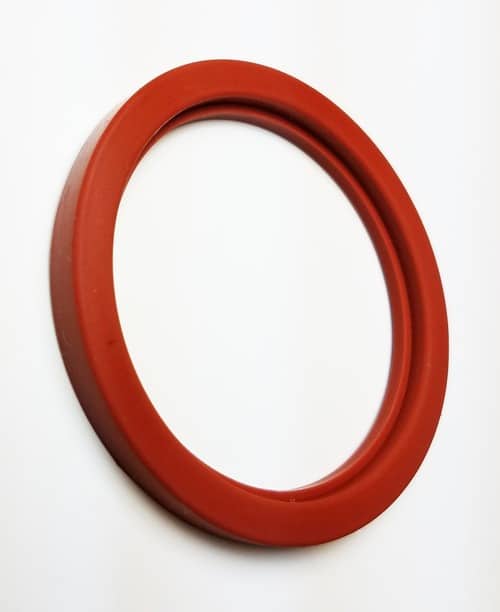
Metal-detectable food-grade silicone gaskets: a practical guide
On a production line, a broken gasket is not just a maintenance issue: it can turn into a stoppage, a full inspection and a contamination risk. That is why the food industry uses food-grade silicone gaskets in specific versions, such as metal-detectable silicone, designed to minimise the risk of fragments and make them easier to detect on the line.
At Manufactures Cusell we manufacture metal-detectable silicone gaskets for food use. If you have dimensions, a sample or simply the mounting point, send us the details and we will quickly tell you whether a metal-detectable solution makes sense for your application.
What is a metal-detectable food-grade silicone gasket?
A metal-detectable food-grade silicone gasket is formulated so that it can be detected by the inspection equipment commonly used in plants. Components such as iron oxide are added to the formulation of this type of silicone, allowing it to be detected by the electromagnets, sensors and magnetic detectors used on internal conveyor lines.
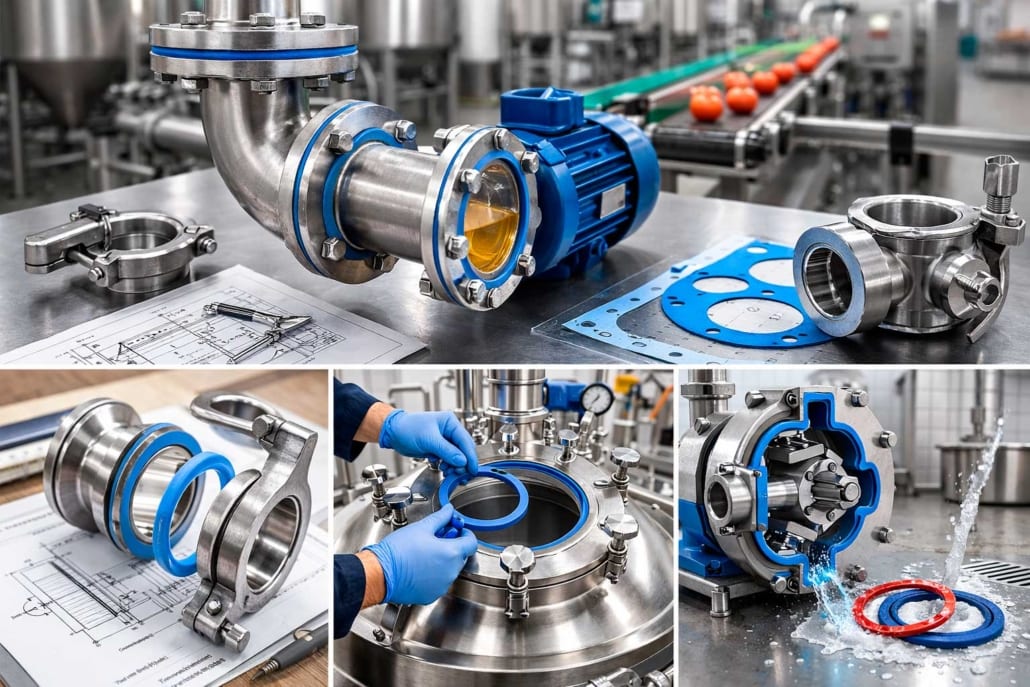
This type of silicone is usually made in blue or contrasting colours to allow additional visual detection in the plant, complementing detection by sensors.
When it makes sense to use it (and when it does not)
There are two scenarios where this material usually makes a difference:
- Risk of breakage due to fatigue or handling: areas with frequent opening/closing, vibration, temperature changes or parts that require recurring maintenance.
- Risk of contact with the product: points where a detached fragment could enter the product stream or a critical area of the process.
On the other hand, if the gasket is in a position where it can never reach the product, or where maintenance eliminates that risk, a standard solution may be enough. In those cases, take a look at our range of silicone gaskets.
How to decide on the shop floor whether you need a metal-detectable gasket
If you want a practical rule of thumb (very much a shop-floor one), try this filter:
- If it breaks, could it end up in the product? → this usually justifies metal-detectable.
- If it breaks, does it cause a long stoppage and a complex inspection? → this usually justifies metal-detectable.
- If it breaks, is it easy to spot visually and remove safely? → it may not be necessary.
This logic is particularly useful in the food, dairy and pharmaceutical industries, where prevention and traceability matter as much as the sealing itself.
Standard food-grade silicone vs metal-detectable silicone
Standard food-grade silicone is chosen for its sealing capability and process stability. Metal-detectable silicone not only seals but also reduces operational risk at critical points: in the event of breakage or wear, it makes in-line detection easier and improves contamination control.
The practical difference is not just the material, but the “risk it covers”:
- Purpose: standard silicone prioritises sealing and durability; metal-detectable silicone adds a layer of safety to detect fragments if an incident occurs.
- When it pays off: when the gasket is close to the product, there is frequent opening/closing or vibration, or a stoppage means lengthy disassembly and product loss.
- Day to day: quality and production gain control over sensitive points without relying solely on visual inspection.
How to decide quickly (shop-floor criterion):
- If material could get into the product → metal-detectable.
- If the point is “clean”, accessible and not exposed to the product → standard may be enough.
- If you have in-line detection and want the gasket to be part of the inspection → metal-detectable.
If you do not need detectability, consider a standard solution from our range of silicone gaskets. If in doubt, send us the mounting point + cleaning + temperature + format (flat gasket or O-ring) and we will recommend the most appropriate option.
Formats in which it is used
The approach is not “one gasket for everything”, but choosing the format that fits your equipment:
- Flat gaskets (die-cut or custom-made): covers, housings, access hatches, bolted joints.
- Metal-detectable O-rings: when the closure is designed for an O-ring.
If your application calls for an O-ring, also see our O-ring range (and tell us you need the metal-detectable version).
What you need to prepare to specify it (without wasting time)
In production, what saves time is not “talking a lot”: it is providing the key data from the outset. For a metal-detectable silicone gasket, the following is usually enough:
- Dimensions (drawing, sketch or sample) and tolerances, if applicable.
- Type of closure (bolts, pressure, push-fit) and whether there is vibration.
- Operating temperature and cycles (whether it frequently rises and falls).
- Product and environment: direct/indirect contact with food, humidity, etc.
- Cleaning: cleaning agents used and frequency (this is often decisive).
- Quantity: prototype, short run or production.
The detail that is often forgotten: cleaning
On many lines, the critical factor is not the operating temperature but the cleaning chemistry. If your process involves recurring cleaning, tell us which products are used and how often. This helps us propose the most stable solution and avoid premature gasket replacement.
In many cases, the greatest value of a metal-detectable gasket is not the material itself, but the operational peace of mind it provides at critical points on the line.
Frequently asked questions
What is a metal-detectable food-grade silicone gasket?
It is a gasket designed for food use whose formulation allows it to be detected by in-line inspection systems, reducing the risk of contamination and making detection easier in the event of breakage.
Is it only used in the food industry?
That is where it makes most sense, but it is also used in environments where contamination control and traceability are critical, such as pharmaceuticals.
Do you manufacture metal-detectable O-rings?
Yes, we can manufacture custom O-rings or flat gaskets. Tell us the dimensions and operating conditions and we will propose a material and format.