
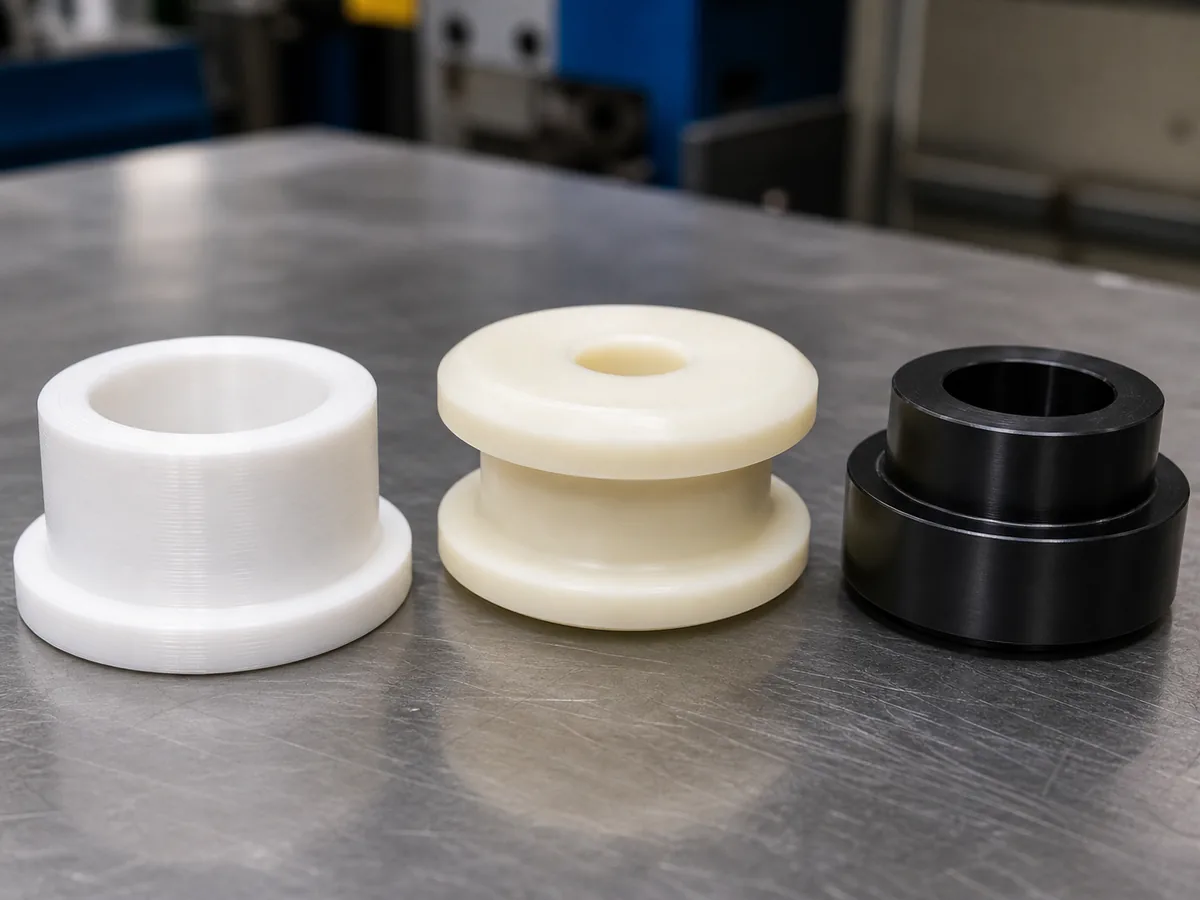
Machined engineering plastic parts: PTFE, Nylon or POM
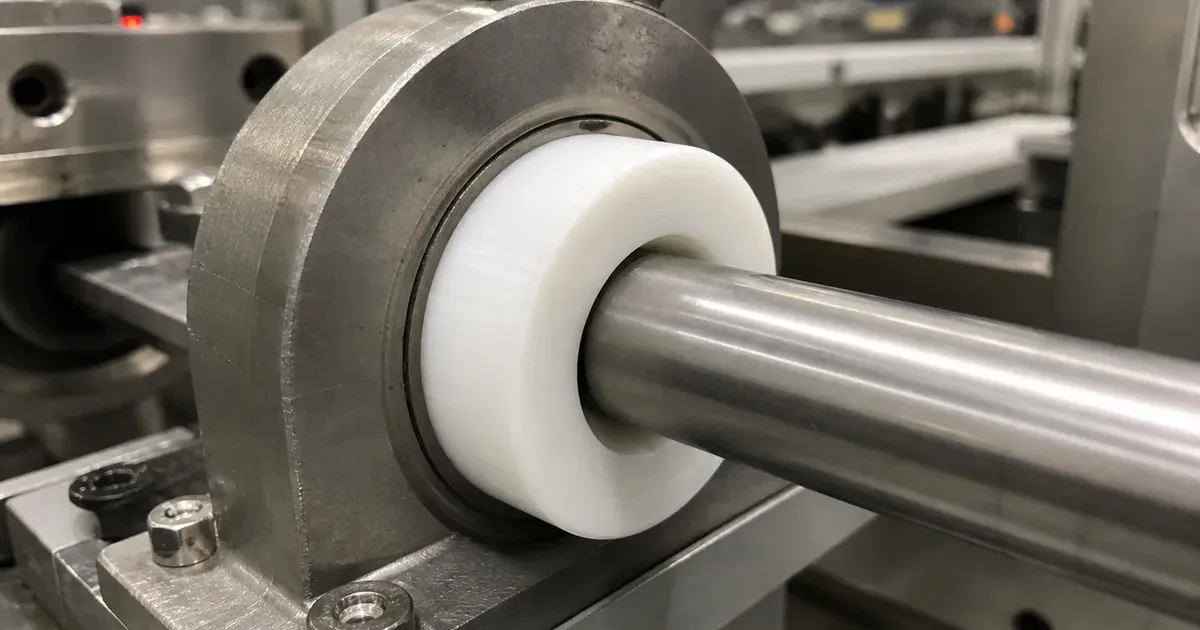
What are engineering plastics?
Engineering plastics are polymer materials designed to work in more demanding conditions than conventional plastics. Depending on the type of material and its formulation, they offer better thermal, chemical, mechanical or dimensional performance.
They are used in machine parts, gaskets, guides, bearings, valves, bushings, washers and components exposed to friction or contact with fluids. That is why they are common in the manufacture of machined plastic parts for custom industrial applications.
Machined engineering plastic parts: PTFE, Nylon and POM
Industrial PTFE: chemical resistance and low friction
PTFE, also known as polytetrafluoroethylene or Teflon®, is one of the most widely used industrial engineering plastics when chemical resistance is the priority.
Its usual temperature range is approximately -200 °C to +260 °C. It stands out for its high stability against acids, solvents and aggressive chemicals. It also has a very low coefficient of friction, which makes it useful for parts where friction needs to be reduced.
In industrial applications, PTFE is used in gaskets for aggressive fluids, components for the chemical, food and pharmaceutical industries, and parts that require a non-stick or low-friction surface. For sealing, PTFE gaskets are a common choice when the fluid or the chemical environment rules out conventional elastomers.
Its main limitation is mechanical. PTFE is not the most suitable material where there are high point loads, significant structural stresses or a risk of deformation under sustained pressure. In these cases, filled PTFE or other engineering materials may need to be considered.
Industrial Nylon: wear, abrasion and mechanical parts
Nylon, or polyamide, is widely used in parts subject to wear. The most common grades are PA6 and PA66.
Its maximum operating temperature is usually around +120 °C, although PA66 can reach approximately +150 °C depending on the grade, formulation and service conditions.
One of its main advantages is its resistance to wear and abrasion. It also offers good resistance to oils, greases and fuels, which makes it a frequent choice for gears, bearings, guides, bushings, supports and structural parts under moderate load.
In industrial Nylon applications, humidity must always be taken into account. Polyamide absorbs water, and this absorption can cause dimensional changes. For parts with tight tolerances, high ambient humidity or frequent contact with water, this point should be reviewed before manufacturing.
That is why Nylon can be a good choice for wear-resistant mechanical parts, but it is not always the best option when stable dimensional accuracy is the main criterion.
POM properties: dimensional accuracy and rigidity
POM, also known as polyacetal or Delrin, is an engineering plastic widely used when rigidity, dimensional stability and good machinability are required.
Its usual temperature range is approximately -40 °C to +120 °C. Compared with Nylon, one of its main advantages is its low moisture absorption. This helps precision parts hold their dimensions better.
The properties of POM make it suitable for valves, cams, gears, transmission elements, precision parts, bushings and components that need a good finish, low friction and geometric stability.
It is also often a good option when the application does not demand chemical resistance as high as PTFE, but does require a rigid, stable part that is easy to machine.
Its main limitation lies in certain chemical environments. It is not the best option in highly alkaline environments or in contact with some aggressive chemical agents. Before choosing it, it is advisable to check the fluid, temperature and concentration.
We review the operating conditions of your part
Before choosing between PTFE, Nylon, POM or another material, it is worth assessing temperature, fluid, load, wear and tolerances. We can help you review these points before the part is manufactured.
Comparison table: PTFE, Nylon and POM
| Material | Max. temp. | Chemical resist. | Wear resist. | Moisture absorption | Typical application |
|---|---|---|---|---|---|
| PTFE | +260 °C | Very high | Medium | Very low | Gaskets for aggressive fluids, low-friction parts, chemical, food and pharmaceutical industries |
| Nylon PA66 | Up to +150 °C | Medium | High | Medium / high | Gears, bearings, guides, bushings and parts subject to wear |
| POM | +120 °C | Medium | High | Very low | Precision parts, valves, cams and transmission elements |
Technical note: values are for guidance only. They may vary depending on grade, formulation, loads, part geometry and actual operating conditions.
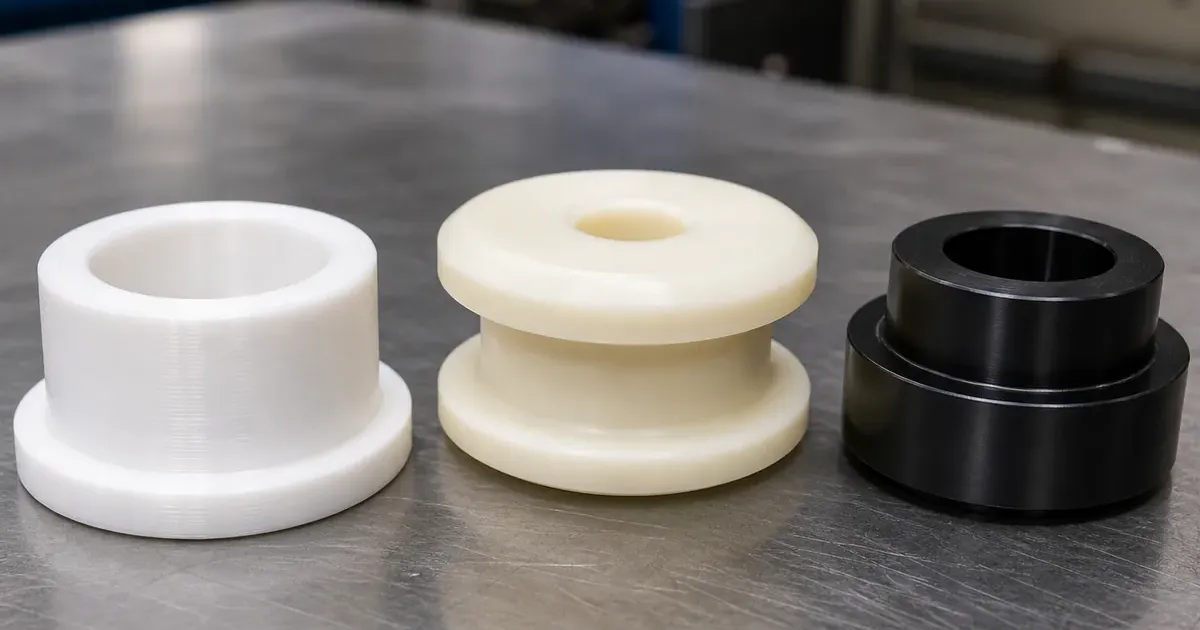
How do you choose the right material?
When machining engineering plastic parts, the choice should start from the application, not just the name of the material. When the fluid is aggressive, with acids, solvents or complex chemicals, PTFE is usually the first choice. For applications where the priority is wear resistance and the load is moderate, Nylon may be more suitable. For parts requiring dimensional accuracy, rigidity and low moisture absorption, POM usually offers better stability.
In food or pharmaceutical applications, it is worth considering PTFE or Nylon with specific certification. If the budget is tight and the conditions are standard, POM or Nylon can be cost-effective solutions. For parts such as spacers, supports or technical washers, the decision will depend on load, temperature, fluid and dimensional tolerance.
Frequently asked questions about industrial engineering plastics
Can PTFE, Nylon and POM be machined?
Yes. All three materials can be machined to produce custom parts. The choice will depend on the geometry, tolerances, quantity, thickness and operating conditions.
What is the best engineering plastic for chemical contact?
In general, PTFE is the safest option when chemical resistance is the main criterion. Even so, it is always advisable to check the specific chemical, its concentration and the operating temperature.
Which material is best for parts subject to wear?
Nylon usually performs well in parts subject to wear, abrasion or mechanical friction. POM can also be a good option when greater dimensional stability is needed.
Which material is best if the part must hold tight tolerances?
POM is usually more dimensionally stable than Nylon because it absorbs less moisture. In precision parts, this can be decisive.
Conclusion
Material selection for machined engineering plastic parts is part of the Manufactures Cusell service. The winner is not always the material with the best overall properties, but the one that best fits the real application. If you have a part, a drawing or operating conditions, we can help you assess the most suitable material.
Need help choosing the right material?
Ask our experts
Tell us about your application, the fluid, temperature, load and dimensions of the part. We will review which engineering plastic will work best before manufacturing.