
Compression in cellular rubbers: a guide for gaskets and profiles
Compression in cellular rubbers: how far can you compress without losing the seal?
When designing cellular rubber or technical foam gaskets, one of the most important factors is the percentage of compression applied during assembly.
Closed-cell cellular rubbers, such as cellular EPDM, silicone or neoprene, are frequently used in sealing applications that call for a combination of flexibility, sealing and the ability to absorb tolerances.
They are common in:
- Flat sealing gaskets
- Sealing profiles for enclosures
- Gaskets for covers, housings and equipment
- Outdoor or industrial applications
However, the performance of these materials depends largely on the compression applied during assembly.
If compression is insufficient, the seal may not be effective.
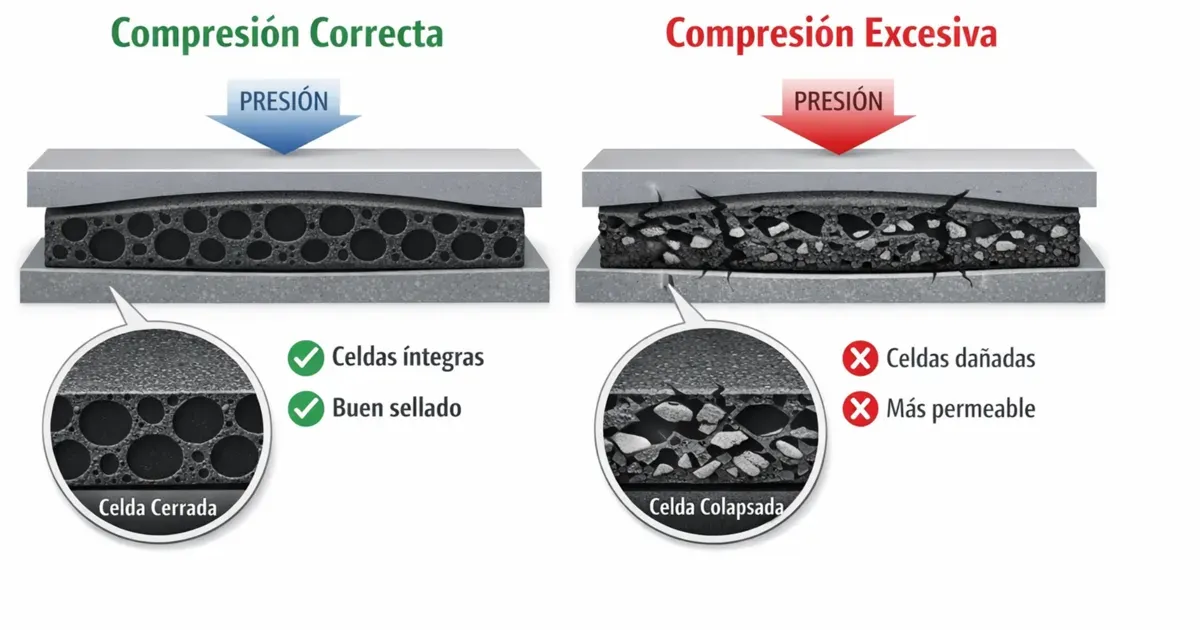
If it is excessive, the cellular structure can be damaged and the material loses some of its properties.
In many industrial applications these materials are used as flat gaskets or as technical foam profiles, cords or tubes, where correct compression is key to ensuring a seal without damaging the material.
What does it mean for a cellular rubber to be closed-cell?
In closed-cell cellular rubbers, the material is made up of small, sealed internal cells containing air or gas.
This structure provides several advantages:
• good compressibility and recovery
• low water absorption
• good sealing against air and liquids
• ability to absorb tolerances or irregularities
When the material is compressed within certain limits, the cells deform but retain their structure.
If compression is too high, the cell walls can break or collapse. In that case the material may become more permeable or lose some of its elasticity.
Typical compression ranges for cellular rubbers
In most industrial applications, the recommended compression for closed-cell cellular rubbers is roughly 15 % to 25 % of the material thickness, as this range maintains the seal without damaging the internal cell structure.
Although each formulation may behave differently, the following guide ranges are commonly used in industrial applications.
Recommended compression
15 – 25 %
Compression still acceptable in many applications
25 – 35 %
Risk zone for cell collapse
35 – 40 %
In this last range, there is a greater likelihood of:
• internal cell damage
• loss of recovery capacity
• increased permeability to air or fluids
For this reason, many designs work with compression values of around 20–25 %.
Practical example: 3 mm cellular gasket
For example, in a cellular rubber gasket 3 mm thick, a typical working compression is between 0.45 mm and 0.75 mm, which corresponds to approximately 15-25 % compression.
Recommended compression
0.45 – 0.75 mm
Typical maximum compression
0.75 – 1.05 mm
Above this range, local damage to the cellular structure may begin to occur, especially if the pressure is not evenly distributed.
Factors affecting actual compression
The behaviour of the material does not depend solely on the compression percentage. Other design factors also play a part.
Density of the cellular material
Denser cellular rubbers usually withstand compression better without the cells collapsing.
Pressure distribution
Uniform compression between two flat surfaces is more favourable than localised pressure (bolts, edges, ribs).
Gasket or profile geometry
In sealing profiles, the shape of the cross-section also determines how deformation is distributed.
Assembly tolerances
One of the purposes of cellular rubber is to absorb tolerances, but these must be taken into account when designing the final compression.
Flat gaskets vs cellular profiles
Behaviour can also vary depending on the type of component.
Flat gaskets
In flat gaskets cut from cellular sheet, compression is usually more uniform if the contact surfaces are even.
Cellular profiles
In extruded or sealing profiles, the profile geometry can concentrate or redistribute compression. That is why cross-section design is particularly important.
In many industrial applications, these profiles can be manufactured as technical foam profiles, cellular cords or cellular rubber tubes, adapted to the cross-section and compression required.
Common mistakes when designing cellular rubber gaskets
Some frequent problems in sealing applications with cellular materials are:
• designing the gasket with too much compression
• not taking assembly tolerances into account
• applying pressure only at specific points
• choosing a material density that is too low for the application
Avoiding these problems usually improves both gasket durability and sealing stability.
Manufacturing gaskets and profiles in cellular rubber
Cellular rubbers are widely used to manufacture:
• flat sealing gaskets
• extruded sealing profiles
• cellular cords
• technical foam tubes
• seals for industrial or outdoor equipment
Depending on the application, materials such as the following can be used:
cellular EPDM
cellular silicone
cellular neoprene
The choice of material, density and working compression range are key factors in achieving reliable long-term sealing.
FAQ on compression in cellular rubbers
How much compression should a cellular rubber gasket have?
In many industrial applications, working at roughly 15 % to 25 % compression is recommended. This range usually provides a good seal without damaging the cellular structure of the material.
Can EPDM foam be compressed by more than 30 %?
In some cases it may work, but the risk of the internal cells collapsing and losing recovery capacity increases. That is why compression is normally kept below this value.
What happens if a foam gasket is over-compressed?
The cell walls can break or become permanently deformed. This can increase permeability to air or fluids and reduce the recovery capacity of the material.
When is it better to use a cellular profile instead of a flat gasket?
Cellular profiles can adapt better to certain geometries and concentrate compression in specific areas of the seal. In many enclosures and housings they are a more effective solution than a flat gasket.
Need help?
Ask us for technical advice
If you already have a drawing or sample, send us the information and we will confirm feasibility and lead time.