
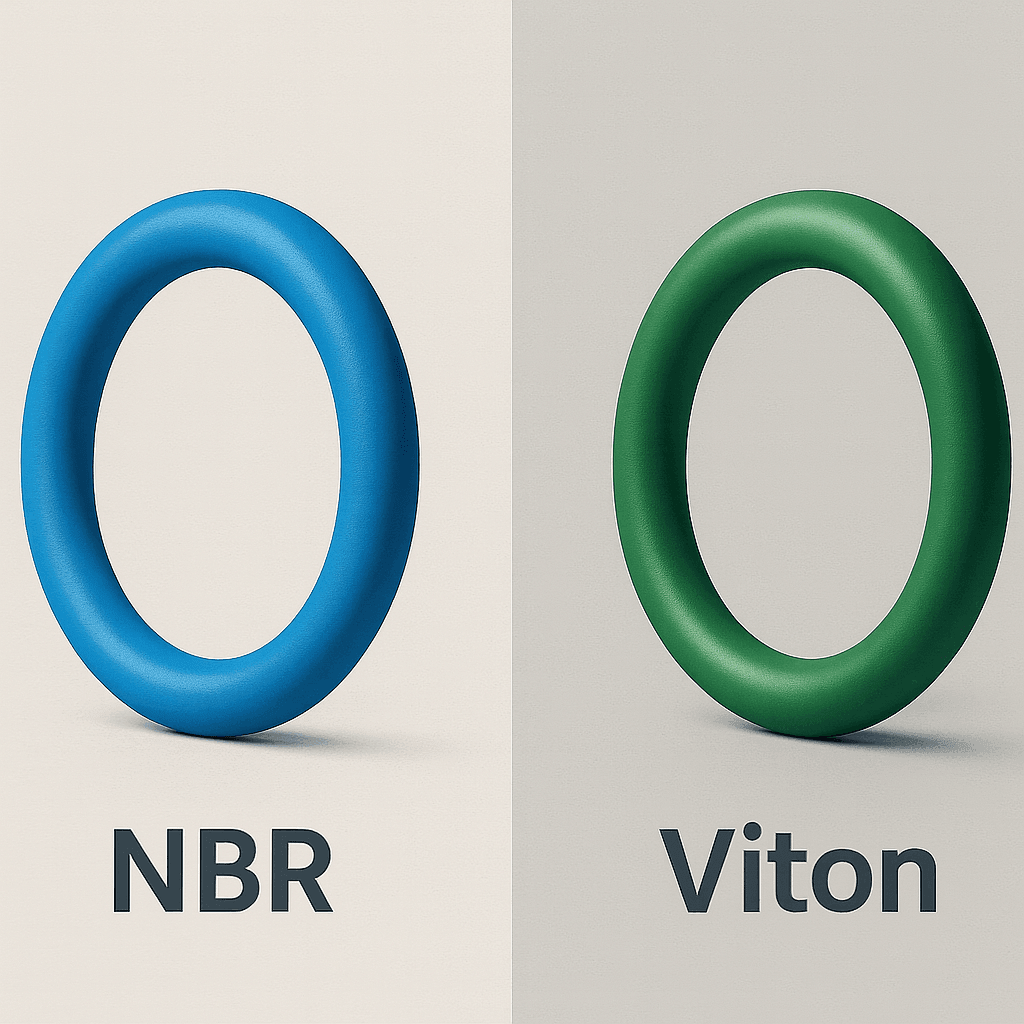
How to choose correctly between Viton and NBR gaskets: common mistakes with industrial O-rings

O-rings are one of the most widely used sealing systems in industry. However, many failures are not due to the design or the size, but to the wrong choice of material.
Viton and NBR seals are two of the most common options. At first glance they may seem equivalent, but they are not.
A poor choice does not usually cause an immediate failure. The problem appears weeks later: loss of sealing, material degradation or unplanned stoppages.
In this article we look at the most common mistakes when choosing between NBR and Viton O-rings, and how to avoid them in real applications.
Why the O-ring material matters more than you might think
A seal can be the right size and still fail in a short time.
The most common mistake is assuming that two O-rings are interchangeable because they have the same geometry. But the material determines how they behave in terms of:
- Temperature
- Chemical compatibility
- Pressure
- Ageing
For example:
NBR → up to +120 °C
Viton® → up to 200 °C continuous (peaks of 250 °C)
In industrial applications, this difference has a direct impact on the durability and reliability of the seal.
🡲 This is where many purchasing decisions go wrong: the size is validated, but the application is not.
Mistake 1 — Choosing NBR when the application requires Viton seals (or vice versa)
NBR is a widely used material thanks to its competitive cost and good performance in standard conditions:
- Mineral oils
- Greases
- Conventional fuels
- Hydraulic and pneumatic systems
In these cases, it is the most efficient option.
Viton seals, on the other hand, are designed for more demanding conditions:
- High temperatures
- Fuels with a high aromatic content
- Solvents and chemicals
- Aggressive industrial environments
The most common mistake is choosing NBR on price alone without validating the actual operating conditions.
Real-world consequences:
- Hardening or swelling of the material
- Loss of sealing
- Frequent replacements
- Production stoppages
🡲 In many applications, the cost of failure far outweighs the initial saving.
Mistake 2 — Relying on colour to identify rubber seals
This is a very widespread practice in workshops and maintenance.
Black → NBR
Green → Viton
But it is not reliable.
Colour does not define the material. A black seal can be NBR, EPDM or another compound.
What is more, different manufacturers use different pigments, even within the same material. This makes visual identification even less accurate.
The only valid identification:
- Technical data sheet
- Material specification
- Supplier reference
This is especially important in purchasing, where misidentification can lead to supply errors.
Mistake 3 — Replacing Viton seals with NBR without validating the application
This mistake occurs mainly in maintenance.
A Viton seal is missing → an NBR O-ring of the same size is fitted → it works… at first.
But it is not working under the same conditions.
Viton seals have superior thermal and chemical resistance. Replacing them without validation can lead to failures within days or weeks if the application is demanding.
Critical situations:
- Temperature >120 °C
- High pressure
- Presence of solvents or chemicals
🡲 It is one of the most expensive mistakes in a plant because it does not fail immediately.
Practical recommendation:
Keep a minimum stock of Viton seals in critical sizes to avoid improvised replacements.
Mistake 4 — Not validating actual chemical compatibility
Both NBR and Viton work with oils, but their behaviour varies greatly depending on the fluid.
NBR → mineral oils, greases, standard fuels
Viton® → better resistance to solvents, acids and aggressive fuels
This point is key in sectors such as:
- Automotive
- The chemical industry
- Processes with complex fluids
A common problem:
The seal works… but its service life is drastically reduced.
🡲 It is not an immediate failure, but it is a certain failure in the medium term.
How to choose correctly between Viton and NBR seals
Before defining the material of an O-ring, you need to understand the actual application.
Key variables:
- Contact fluid
- Temperature (continuous and peak)
- Pressure
- Environmental exposure
Rule of thumb:
<120 °C + mineral oils → NBR
120 °C or chemical environment → Viton seals
Food applications → FDA Viton or silicone (according to the technical data sheet)
🡲 If you are comparing materials for a specific application, the most important thing is not price but compatibility.
Frequently asked questions about Viton and NBR O-rings
What is the difference between an NBR O-ring and a Viton seal?
NBR is a cost-effective material for standard applications. Viton® is a fluoroelastomer with higher thermal and chemical resistance, designed for more demanding environments.
When should you use Viton O-rings instead of NBR?
When there are high temperatures, solvents or aggressive fuels, or when greater durability is needed.
What is the temperature range of each material?
NBR works between –40 °C and +120 °C. Viton seals can work up to 200 °C continuously and withstand higher peaks.
Can Viton and NBR seals be interchanged?
Not always. Even if they have the same geometry, their properties are different. Replacing one with the other without validation can lead to sealing failures.
Are Viton seals always more expensive?
Yes, but they also offer greater durability. In demanding applications, they are usually more cost-effective in the medium term.
Does the colour identify the gasket material?
No. It is only a rough guide. The only reliable way is the material's technical data sheet.
Need help choosing the right material?
Ask our experts
If you are unsure which material to use in your application, we can help you define the most suitable solution for your actual operating conditions.